KCTC’s Kara Lowe Moderates Global Tech Leaders at KCHouse
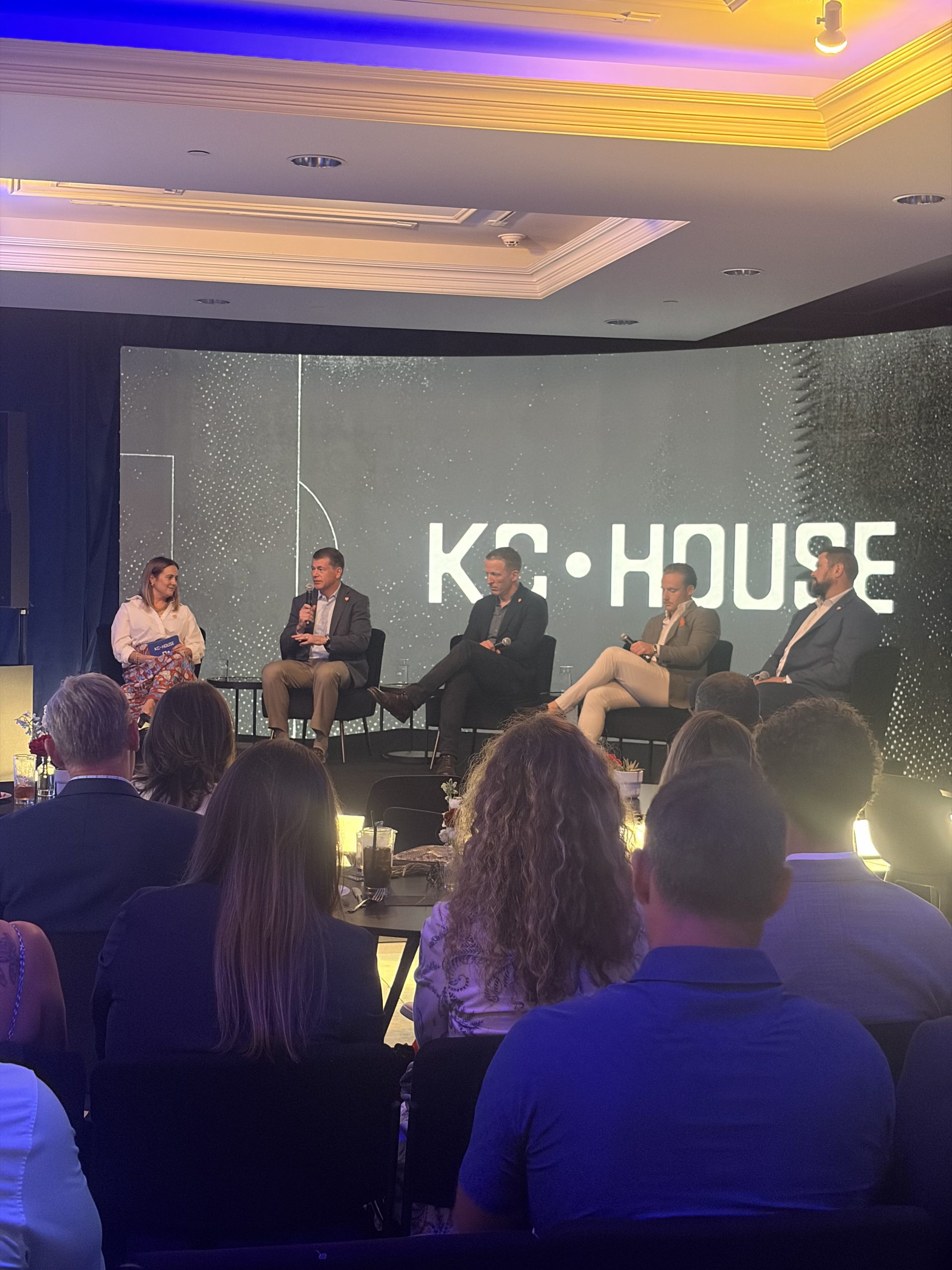
Leaders from across the globe gathered Wednesday afternoon at KCHouse, a world-class hospitality and business attraction, during FIFA World Cup 26™ Kansas City, to explore how different regions can deliver power, resilience and the infrastructure required to meet today’s tech demand. KC Tech Council CEO Kara Lowe led powerful discussions focused on how to address the rapid acceleration of tech.
The ultimate takeaway from the sessions is the powerful shift in perspective; the theme of the day was not strictly innovation, but integration.
The first panel, “Powering the AI Economy: Innovation to Build the Infrastructure of the Future,” featured David Campbell, president & CEO of Evergy; Will Conkling, head of data center energy, Americas at Google; Josh Johnson, VP, technology at Black & Veatch; and Eric Douw, business development & sales, Americas at KUBO.
“Innovation moves at the speed of demand,” Lowe said.
The surging energy demands of data centers and rapid AI growth require fundamental resource integration, not just optimization. For example, exploring the symbiotic relationships between tech and agriculture with integrated data centers and greenhouses can create opportunities to reuse waste heat and CO2 from servers in farming operations. Hyperscalers and utility companies are also shifting paradigms by collaborating throughout the design/build process of new infrastructure, working alongside regulators to create specialized rates for large data center loads while protecting everyday consumers.
The second panel, “Building at Scale: AEC’s Role in Powering the Next Generation of Tech Infrastructure,” featured Rebecca Gannon, public affairs at Nebius; Jim Moos president of technology, industrial & governments at Black & Veatch; Chris Teddy, SVP mission critical at JE Dunn; and Usman Wajid, Founder & CEO, Block & Mortar.
These leaders discussed how need increases for data centers and high-powered AI factories create pressure on the architecture, engineering and construction (AEC) sectors, which currently face demand scaling far beyond current capacity.
To overcome supply chain hurdles and power constraints, the AEC industry must also lean heavily into integration.
Getting key players around the table from the start to collaborate across disciplines is the key to success. This collaborative mindset extends to massive workforce development initiatives. Currently, JE Dunn utilizes a program bringing employees into the field to work in underserved communities with an 89% retention rate, and Black & Veatch continues a push to effectively scale their workforce to 10,000 by 2028.
These powerful discussions serve as a thoughtful reminder for the region: The tech infrastructure of the future won’t be built by a single innovative technology, but by the seamless integration of our energy systems, our construction processes and the willingness to collaborate throughout our communities.

![Central white cover displays tech logo and title, over a black-and-white city skyline with a classical train station and a circular reflecting pool in a tree-lined park.
Text (transcribed exactly):
KC
Tech Council
KC TECH SPECS
[v.08]
PRESENTED BY:
RSM](https://www.kctechcouncil.com/wp-content/uploads/2025/10/KCTC_TechSpecsv.08-768x432.jpg)
![Woman with shoulder-length brown hair smiling at the camera, seated indoors against a blurred background; teal lower banner reads: STARTLAND [S logo] NEWS.](https://www.kctechcouncil.com/wp-content/uploads/2025/11/KCTC-Startland-Graphic.jpg)